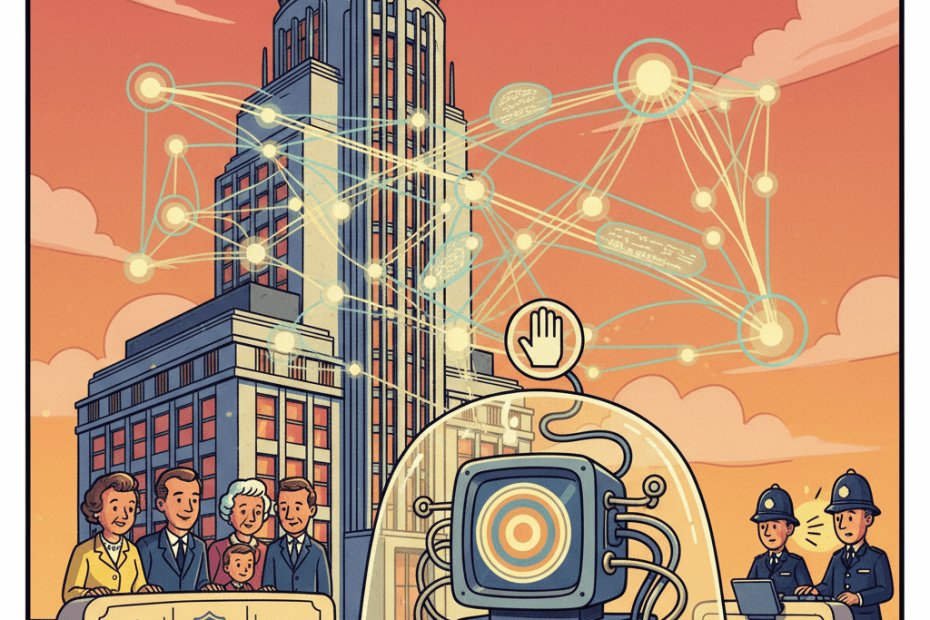
The Metropolitan Police has reportedly begun investigations into hundreds of officers after using an AI-powered tool from Palantir to look for possible misconduct in staff data.
According to the Guardian, the system was used over the course of a week to examine information the force already held, with potential issues ranging from work-from-home rule breaches to more serious allegations. The Met has said the work forms part of an effort to identify corruption, abuse and other conduct problems inside the organisation.
For ordinary readers, this is not just a policing story. It is a useful example of how AI and large-scale data analysis are moving into sensitive public services. The same broad idea — software looking across many records to find patterns that humans might miss — is now appearing in workplaces, councils, healthcare, finance and safety teams.
What the AI is doing here
The important detail is that this is not a chatbot answering a casual question. It is closer to a pattern-finding system. Tools like this can join together existing records, flag unusual behaviour, highlight links between people or events, and help investigators decide where to look next.
That can be genuinely useful. Large organisations often hold more information than any person can sensibly review. If an officer, employee or contractor is abusing access, breaking rules or showing warning signs across several systems, a well-designed tool may spot the pattern faster than a manual review.
But that usefulness is exactly why the safeguards matter. A tool that can search across internal records can also feel intrusive, unfair or opaque if people do not know what data is being used, what counts as suspicious, and who checks the result before action is taken.
Why this matters beyond the Met
ManyHands readers are likely to meet this kind of AI in less dramatic settings. It might be fraud monitoring at a bank, a workplace system checking unusual login activity, software that reviews expenses, or a council tool that helps prioritise investigations.
The promise is efficiency. The risk is overconfidence. AI can be good at finding signals, but a signal is not the same as proof. A flagged account, employee or case still needs human judgement, context and a fair process.
That is especially true in policing, where public trust is already fragile and the consequences of mistakes can be serious. If a system helps identify real wrongdoing, that could protect the public and honest officers. If it creates false suspicion, misses important context, or is used without enough oversight, it could damage trust further.
This is the same lesson that applies when personal AI tools are given more permission to act. In our guide to AI tools ignoring instructions and why permissions matter, the key point was that access changes the risk. A tool that can only summarise text is one thing. A tool that can search across sensitive records is another.
The questions worth asking
When public bodies use AI or AI-like analytics, the public does not need every technical detail of the model. But people do deserve plain answers to practical questions.
- What data is being used? Is the tool looking only at work systems and official records, or does it pull in broader information?
- What does a flag mean? Does it trigger a human review, a formal investigation, or an immediate consequence?
- Who checks the tool? Are there independent audits, bias checks and clear routes to challenge mistakes?
- How long is data kept? Powerful searches can become riskier if old or irrelevant data is retained indefinitely.
- Is the supplier accountable? If a private company provides the technology, the public body still needs to explain and own the decisions made with it.
These questions are not anti-technology. They are how useful technology earns trust.
AI can support accountability, but it cannot replace it
There is a tempting story around AI in public services: that software can finally make messy human institutions cleaner, faster and more objective. Sometimes it can help. But software does not remove the need for leadership, transparency or due process.
A misconduct investigation still needs evidence. A person being investigated still needs fairness. A public organisation still needs to explain why a tool was chosen, what limits it has, and how it prevents abuse.
That is also why readers should be careful with simple headlines about AI “catching” people. The better framing is that AI may help investigators decide where to look. It should not be treated as a magic truth machine.
We have seen similar caution with consumer chatbots. In our piece on chatbots that agree too readily, the warning was not that AI is useless. It was that people need to understand what the system is good at, where it can mislead, and when a human check is essential.
What to watch next
The next test is not simply whether the Met opens more cases. It is whether the force can explain the process clearly enough for officers, oversight bodies and the public to understand it.
Look for whether the Met publishes more detail on governance, review routes and data use. Watch whether oversight organisations ask for stronger transparency. And pay attention to whether similar tools appear elsewhere in UK public services, because this kind of internal monitoring is unlikely to remain a one-off experiment.
For everyday readers, the takeaway is straightforward: AI that looks for patterns can be powerful and useful, but the more sensitive the setting, the stronger the checks need to be. In policing, health, benefits, banking or employment, “the computer flagged it” should be the start of a careful human process, not the end of the conversation.