Most smart TV upgrades sound more useful in the announcement than they do in the living room. A tidier menu is nice, but it rarely changes how people actually use the telly.
Google’s latest Gemini update for Google TV looks a bit more practical than that. The company has announced three new features: richer visual answers when you ask a question, “deep dives” that turn the TV into a narrated explainer screen, and sports briefs that summarise what is happening in major leagues.
For UK households, the real question is not whether that sounds futuristic. It is whether it will make the TV meaningfully more helpful, or just add another layer of AI varnish to a device that already does plenty. The honest answer is that it could be handy, but only if expectations stay sensible.
What Google is actually adding
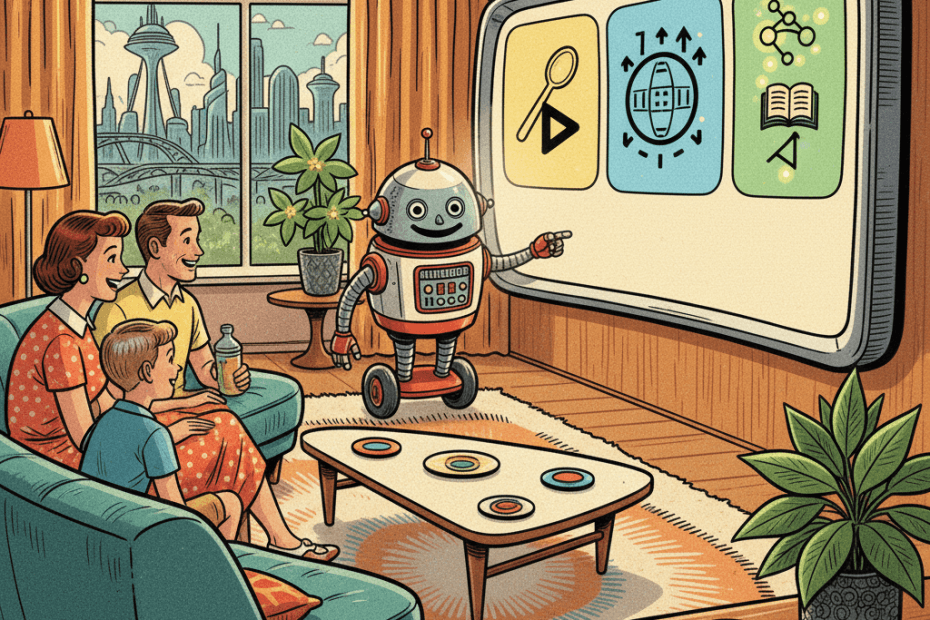
According to Google, Gemini on Google TV can now respond to some questions with a more visual mix of answers. Ask about a sports match and you may see a live scorecard and where to watch. Ask for a recipe and you may get a video tutorial alongside the usual answer. That is a small but useful shift from a voice assistant reading things out to something more like an on-screen helper.
The second feature is “deep dives”, which are narrated visual walkthroughs on topics such as health and wellness, economics and technology. If that works well, it could suit exactly the sort of moments that happen in normal homes: somebody asks how something works, someone else wants a quick explainer, and nobody quite wants to disappear into a phone.
The third addition is sports briefs, which give short narrated updates on supported leagues. That is not revolutionary, but it is easy to understand. Plenty of people just want the score, the basic story and whether a match is worth catching up on later.
Why this could genuinely be useful
There is a sensible version of this idea. The biggest screen in the house is already where people watch tutorials, follow recipes and settle random debates. If Gemini can pull together video, visuals and a short explanation without making everyone reach for their phones, that is real convenience rather than pure hype.
It also fits a broader pattern. Google is pushing Gemini into more everyday devices, and its recent Android experiments show the company wants the assistant to sit across normal consumer tech, not just inside a chatbot window.
There is also something reassuringly low-stakes about this version of AI. Compared with an assistant controlling files, sending messages or steering purchases, a TV helper answering a recipe question or summarising last night’s sport is relatively easy to supervise.
The UK reality check
Before anyone in Britain assumes their television is about to become dramatically smarter overnight, Google’s rollout details matter. Richer visual help is beginning first on Gemini-enabled devices in the US and Canada. Deep dives and sports briefs are also starting on Gemini-enabled devices in the US, with broader device support promised later in the spring. Google says the Gemini voice assistant for Google TV will expand to more countries this year, starting with Australia, New Zealand and Great Britain this spring.
That is promising, but it is not the same as “available now on your current set”. Google’s own small print says the experience is limited to select devices, countries and languages, and needs Android TV OS 14 or later, a Google account and an internet connection. So the practical UK message is simple: this is coming, but probably gradually.
Where caution still makes sense
The first caution is accuracy. Google says results may vary and should be checked for accuracy. A muddled sports summary is no great drama, but a confident answer on a health or wellbeing topic could be more problematic if people treat it as reliable guidance rather than a starting point.
The second caution is that not every AI feature improves home life just because it sits in the living room. As we have argued before, AI tends to work best as a helper rather than a substitute. That applies neatly here. Useful for quick orientation, not a replacement for judgement, proper research or actual conversation.
There is also the usual data question. Asking a TV natural-language questions about routines, interests, children’s curiosities or health topics can reveal quite a lot about a household over time. That does not make the feature sinister by default, but it does mean it deserves the same common sense people should apply to any other voice-enabled AI service at home.
The non-hypey takeaway
Google TV’s new Gemini features look more grounded than many recent AI announcements because they are tied to ordinary moments: what should we cook, what happened in the match, can someone explain this properly on a bigger screen? That is a better fit for home AI than forcing a chatbot into chores nobody wanted automated.
Still, UK readers should keep their expectations sensible. If the rollout is smooth, this could make some Google TV devices a bit less clunky and a bit more helpful. If it is patchy, it may end up as one more feature people ignore after the novelty wears off.
For now, the fairest verdict is that this looks promising, but not essential. If you already have the right kind of Google TV device, it may become a genuinely handy household extra. If you do not, you are not missing some vital new way to watch telly.
Sources:
Google Blog — 3 new Gemini features are coming to Google TV
Engadget — Three new Gemini features come to Google TV
TechCrunch — Google TV’s new Gemini features keep fans updated on sports teams and more