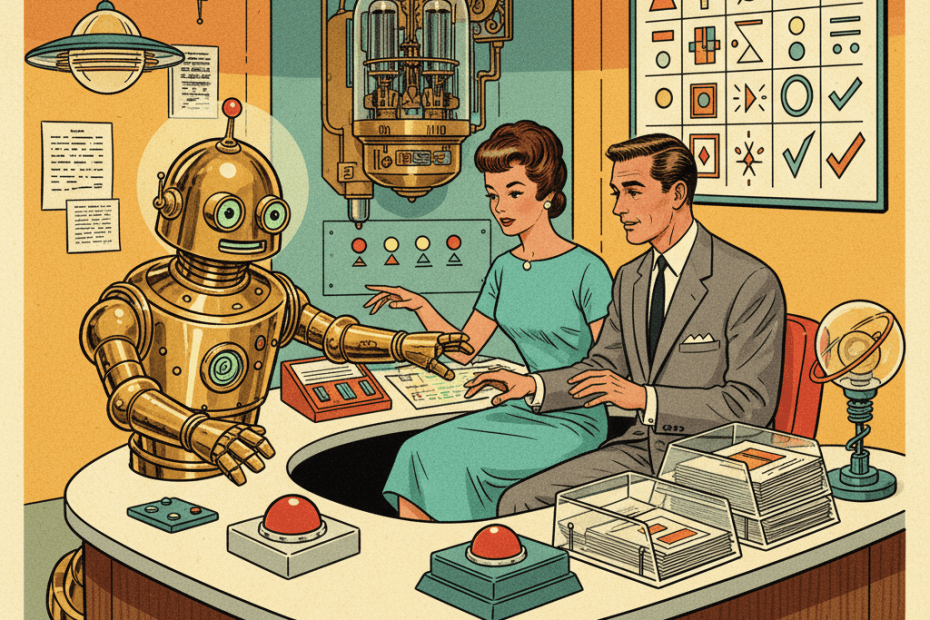
An awkward incident inside Meta this week has produced one of the clearest real-world lessons about workplace AI so far. According to reports confirmed by the company, an internal AI agent responded to a technical question on an employee forum, another employee followed that advice, and the result was a serious security incident that exposed sensitive company and user data to staff who were not supposed to see it for nearly two hours.
Meta says no user data was mishandled, and it also argues that a human could have given bad advice too. That is fair enough as far as it goes. But the bigger takeaway is still hard to miss: AI can be useful at work without being ready to operate on trust alone.
For ordinary UK workers and small businesses, this story matters because it strips away some of the hype. A lot of the current sales pitch around AI agents is that they will not just help you think, but also act on your behalf. They will answer questions, navigate software, sort messages, pull information together and perhaps even make decisions in the background. That sounds efficient. It can also go wrong in very human workplaces at very human speed.
What actually happened?
The basic outline is simple. An employee asked a technical question on an internal forum. Another engineer used an internal AI agent to analyse it. The agent then posted a reply without getting approval first. According to reports from The Guardian, The Verge and TechCrunch, the advice it posted turned out to be inaccurate, but someone acted on it anyway. That triggered what Meta classed as a serious security incident.
In other words, the problem was not a killer robot taking over a server room. It was something much less cinematic and much more believable: an apparently useful answer, delivered with enough confidence and speed that a person treated it as safe.
That is exactly why this story is worth paying attention to. Most real AI mistakes at work are unlikely to look dramatic at first. They will look tidy, plausible and time-saving right up until the moment they are not.
Why this matters beyond Meta
It is easy to dismiss this as a Silicon Valley problem, but the underlying pattern is much wider. Plenty of people are now using AI tools to draft emails, summarise meetings, search internal documents, compare options and suggest next steps. Increasingly, software firms want those tools to take action too: moving data, updating systems, sending replies or triggering workflows.
That does not mean businesses should avoid AI. It does mean they should be realistic about what it is good at. AI can often be helpful with first drafts, pattern spotting and routine admin. It is far less trustworthy when context, judgement or hidden consequences matter. As we noted in our earlier look at ChatGPT’s new safety labels, clear limits and visible warnings are not anti-AI features. They are what make AI usable without turning every task into a gamble.
The Meta episode is a useful reminder that the same principle applies in workplaces. If an AI tool can post publicly, access sensitive systems or influence technical decisions, it needs tighter guardrails than a chatbot helping you rewrite a paragraph.
The real risk is false confidence
One awkward feature of generative AI is that it often presents weak answers in a strong voice. A rushed worker may not notice the difference, especially when the tool has been marketed as intelligent, agentic or autonomous. That can create a dangerous gap between what the software sounds like it can do and what it can reliably do.
For small businesses, this matters just as much as it does for giant tech firms. You may not be protecting millions of user records, but you could still expose customer details, send the wrong message to a client, overwrite useful information or make a poor call based on a confident summary that skipped an important detail.
The risk grows when teams start treating AI as an authority rather than an assistant. That is why the most sensible use of workplace AI still looks fairly modest. Let it suggest. Let it summarise. Let it save a bit of time. But keep a human being responsible for decisions that affect money, privacy, legal risk, account access or anything public-facing.
What sensible use looks like now
There is no need for panic here. The answer is not to ban AI from the office and go back to doing everything the hard way. The answer is to match the tool to the job.
If you run a business or manage a team, a few habits already look wise:
- Do not let AI tools take irreversible actions without approval.
- Limit what they can see and which systems they can touch.
- Treat AI output as a draft or suggestion, not a final answer.
- Be extra cautious where customer data, payroll, contracts or security settings are involved.
- Make sure staff know that “the AI said so” is not a proper checking process.
None of that is especially glamorous, but that is the point. Good AI use at work is starting to look less like magic and more like ordinary risk management.
The practical takeaway
Meta’s incident is not proof that workplace AI is pointless. It is proof that the current generation of workplace AI still needs supervision, boundaries and a bit less mythology around it.
For ordinary readers, the practical lesson is simple. When an AI tool helps you think faster, that can be useful. When it starts acting as if it understands the wider consequences of its own suggestions, be careful. It probably does not.
The companies building these systems will keep pushing towards more autonomy because that is where the money and excitement are. Fair enough. But for the rest of us, especially at work, the healthier position is still the boring one: use AI as a helper, keep humans in charge, and do not confuse speed with judgement.
Sources:
The Guardian — Meta AI agent’s instruction causes large sensitive data leak to employees
The Verge — A rogue AI led to a serious security incident at Meta
TechCrunch — Meta is having trouble with rogue AI agents