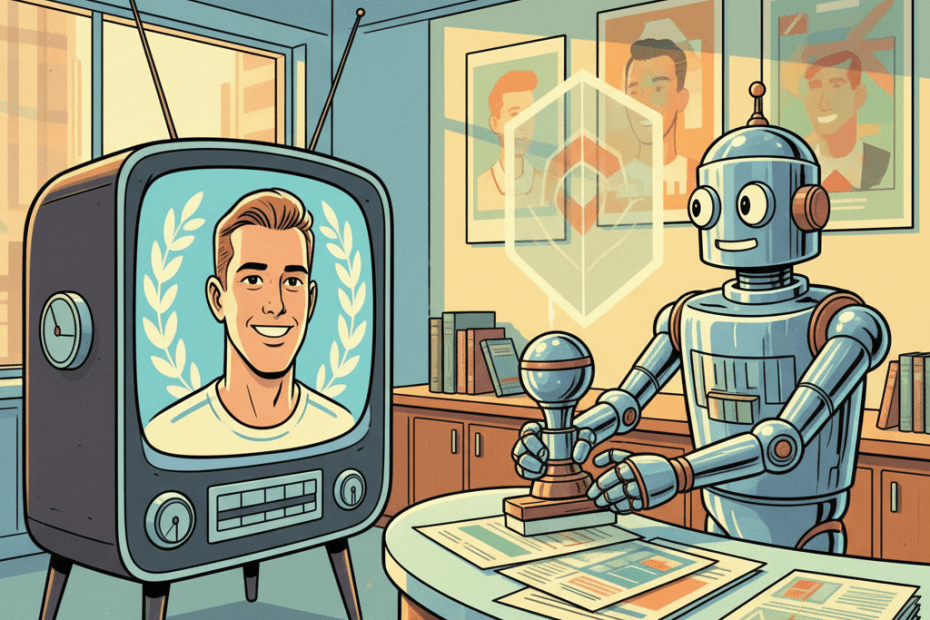
One of the more practical AI stories in the UK this weekend is about darts champion Luke Littler applying to trademark his face.
That may sound like celebrity brand management, but it also points to a broader problem: once generative AI tools can copy a face, a voice or a style in seconds, the line between imitation and misuse gets messy very quickly.
According to the BBC, Littler has applied to the Intellectual Property Office to trademark his face in a move intended to stop it being reproduced without permission, including by generative AI. The detail that matters here is not just that a famous teenager is protecting his image. It is that even in 2026, there is still no simple, catch-all UK law that says, in plain terms, “your face is your property”.
Why a trademark matters here
In the UK, a registered trade mark can help protect a brand in commercial settings. GOV.UK says registering one can let someone take action when a brand is used without permission, put the registered symbol next to it, and license it to others. In practice, that makes trade marks useful when a name, logo or recognisable identity is part of a business.
That is why this move makes sense for Littler. He is not just a sports star; he is also a commercial brand. If his image appears on products, promotions or AI-generated merchandise, a trade mark gives him something more concrete to point to when he challenges it.
But it is important not to oversell what this does. The BBC quotes legal experts saying a trade mark is not a magic shield against all fake images. It may help with commercial exploitation and licensing, but it is unlikely to stop every dodgy edit or AI-generated lookalike circulating online.
The awkward UK gap
This is the bit ordinary readers should notice. HMRC’s own manual states that, as a general principle, UK law does not recognise a standalone “image right” or “personality right”. Instead, protection comes from a patchwork: trade marks, copyright in particular images, privacy law in some situations, passing off claims, and contracts.
That may sound technical, but the everyday version is simple enough: if somebody misuses your face or likeness in the UK, the answer to “what law protects me?” is often “it depends”. That is not very satisfying in a world where AI can generate realistic fake visuals cheaply and at scale.
For celebrities, athletes and influencers, that gap matters because their image is part of how they earn money. For everyone else, it matters because the same technology does not stay neatly inside celebrity culture. The tools used to make fake endorsements or fake adverts about famous people are often very similar to the ones that can be used for scam ads or humiliating hoaxes involving ordinary people.
What regular people should actually take from this
The first lesson is that AI fakes are not just a Hollywood problem. They are becoming part of mainstream life, and the law has not fully caught up. If something looks convincing online, that no longer tells you very much. A familiar face, a plausible quote and a polished image can all be manufactured.
The second lesson is that legal protection is still uneven. If a fake image is being used to sell something, imply endorsement or trade on somebody’s reputation, there may be stronger routes for action. If it is just circulating socially, or made anonymously, things can get harder. That is one reason why clearer labelling and better platform safeguards matter so much. We touched on that recently in our piece on AI safety labels: when AI-made content gets harder to spot, ordinary users need clearer signals, not fewer.
The third lesson is not to panic, but to get a bit more streetwise. If you see an advert, social clip or viral image using a celebrity face to push a giveaway, investment scheme or miracle product, treat it with the same suspicion you would give a badly written phishing email. The visuals are getting better. That does not make them more trustworthy.
What this does and does not solve
Littler’s application looks sensible as a defensive move, and it may become increasingly normal for public figures to protect names, catchphrases, signatures and facial likenesses wherever the law allows. It is a rational response to a technology that can turn identity into raw material.
Still, it would be a mistake to read this as a full solution. Trade marks are mainly about commercial use, not total control over every imitation. They do not remove the wider problems around deepfakes and impersonation spreading faster than complaints can be processed.
That is why this story is bigger than darts. It is about how society decides who gets control when software can remix a person’s identity. The UK has already been wrestling with similar questions around ownership and creative work, as we noted in our recent piece on the UK’s AI copyright climbdown. Faces, voices and styles are turning into the next frontier.
The reassuring part
A reassuring takeaway is that people are not powerless. Public figures are using the tools available, and the legal system is starting to acknowledge that AI changes the risks around identity. That does not solve everything, but it is better than pretending the problem does not exist.
For ordinary readers, the useful habit is not becoming an expert in trade mark law. It is understanding the shape of the moment. AI makes fakery cheaper, faster and more believable. The response, for now, is a mix of common sense, scepticism and piecemeal legal protection.
Luke Littler trademarking his face is worth attention. It is a celebrity story on the surface, but underneath it previews a future where proving what is really you becomes part of everyday digital life.
Sources:
BBC News — Luke Littler to trademark his face to combat gen-AI deepfakes
GOV.UK — Register a trade mark
HMRC manual — Image rights in the UK